Transferring knowledge to farms drives Iran’s sustainable food security
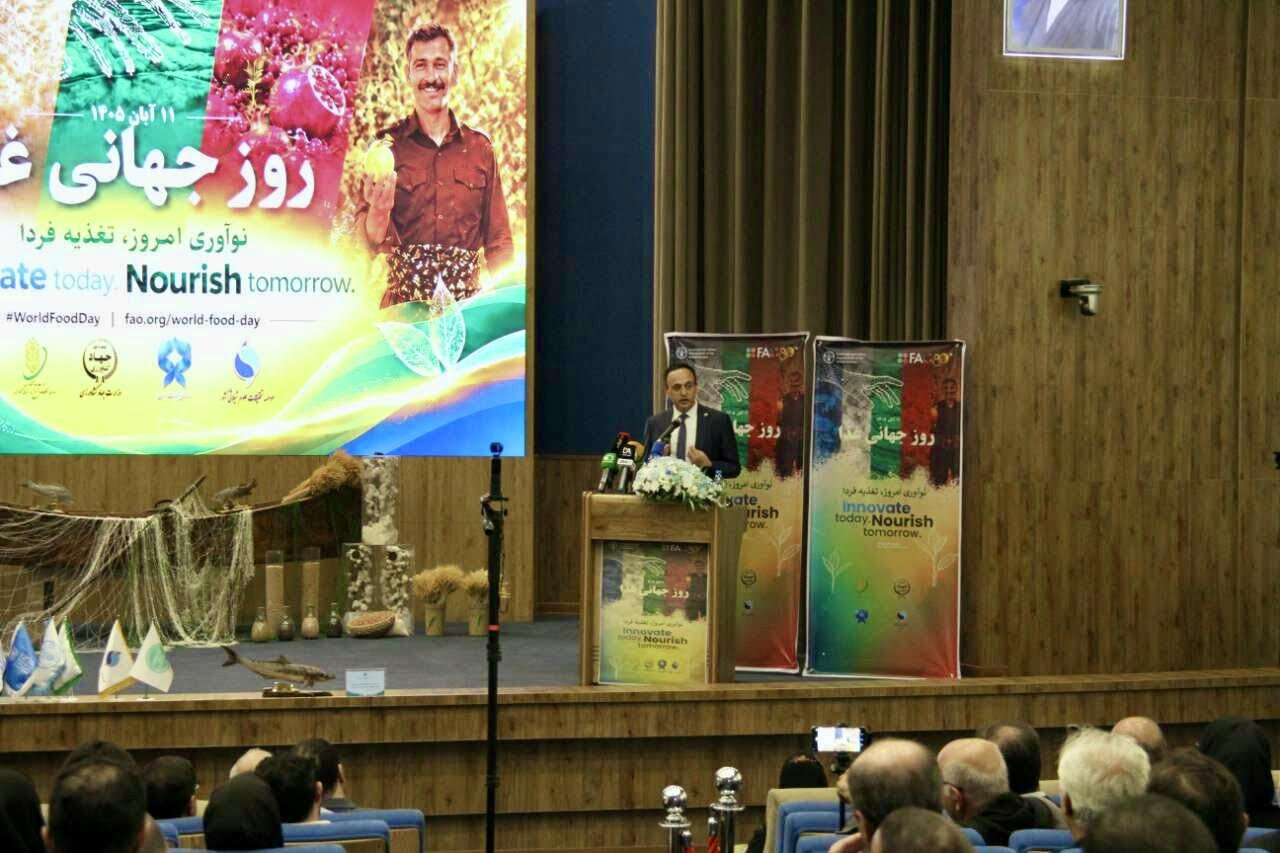
TEHRAN- At a World Food Day conference in Tehran, hosted by the Agricultural Research, Education and Extension Organization (AREEO) and the Ministry of Agriculture, senior officials stressed that scientific research must be linked directly to the real needs of agricultural producers.
Gholamreza Golmohammadi, Deputy Minister of Agriculture and Head of AREEOC, said the transfer of knowledge to farms is the agricultural sector’s priority for achieving sustainable food security.
He argued that agricultural research has moved beyond simply producing papers and implementing research projects; it is now focused on solving farmers’ problems, increasing resource productivity, and ensuring a stable supply of food for the population.
Golmohammadi noted that climate change, the water crisis, resource limitations, and rising production costs have created serious challenges for global food security. In such conditions, innovation is essential to maintain production and increase agricultural resilience. Referring to a FAO report on the state of food security in 2026, he said about 645 million people worldwide have faced difficulty accessing sufficient food. This shows that despite scientific progress and increased production capacity, access to food remains a major global issue.
He pointed to this year’s World Food Day theme, “Innovation today, nutrition tomorrow,” and stressed that innovation should not be limited to complex technologies. It also includes introducing drought-resistant varieties, improving irrigation methods, scientifically managing plant nutrition, reducing pest and disease damage, and improving post-harvest storage. Innovation can play an effective role in food security only when it solves producers’ problems, lowers production costs, and simultaneously increases yields and improves the quality of agricultural products.
Golmohammadi said the future of food production depends on knowledge and technology development. Given limited water resources and growing environmental stresses, research activities must be directed more than ever toward answering the real needs of the agricultural sector. The success of agricultural research should not be measured only by the number of papers, research projects, or technologies produced. Instead, it must be shown how much each scientific achievement has contributed to reducing water consumption, increasing crop yields, protecting basic resources, and producing safe food for consumers.
He noted that the current Iranian year 1405 has been designated as the “Year of Education and Extension” in the organization. The aim is to create the conditions for transferring knowledge and technology produced by AREEOC, universities, and scientific and research centers to farmers and beneficiaries. He emphasized the connection among research, education, and extension, saying these three areas complement one another and the organization’s missions cannot be fulfilled without effective links among them. Researchers must first identify production problems and challenges, then provide scientific solutions that allow farmers to use research findings in practice. Golmohammadi said AREEOC has moved away from research solely for publication or academic promotion and has focused its programs on problem-oriented research, solving agricultural challenges, and increasing the impact of knowledge in production.
Impact on production as the criterion: smart cropping and digital forecasting
Golmohammadi highlighted the capacity of modern technologies for managing agricultural production. He said the use of digital technologies, remote sensing, and artificial intelligence is a priority for AREEOC, and important steps have been taken in this field over the past two years. A Center for Monitoring the Agricultural Production Pattern was established in the Iranian year 1404 to draft, implement, and monitor cropping patterns using smart methods. In this framework, the fifth version of the cropping pattern for field crops was issued this year. The first production pattern versions for parts of fisheries, greenhouse cultivation, and medicinal plants have also been issued. Drafting and issuing production patterns for wood plantations and livestock production based on land-use planning are on the agenda.
He also referred to the development of remote sensing systems, saying these systems make it possible to accurately estimate cultivated areas and forecast agricultural production about two months before harvest. They can be effective tools for production planning and managing the needs of the agricultural sector. These remarks reinforced the broader message that research and technology must be judged by their practical impact on production, resource use, and farmers’ livelihoods, not by abstract academic outputs alone.
The FAO Representative in Iran, Farrukh Toirov, also addressed the conference and argued that increasing agricultural production alone does not guarantee food security. It leads to food security only when all households have sustainable access to healthy, nutritious, and affordable food. He said innovation must turn scientific knowledge and practical experience into solutions that improve people’s livelihoods, strengthen food systems, and protect natural resources for future generations.
Referring to the theme “Innovation today, nutrition tomorrow,” the FAO representative said the world has made considerable progress in agriculture, but the main challenge remains turning those gains into sustainable food security and creating conditions for all people to access sufficient and healthy food. Citing FAO data, he said global cereal production reached about 3.1 billion tons in 2024, a 27 percent increase compared with 2010. However, higher production alone cannot guarantee sustainable household access to healthy, nutritious, and affordable food.
Toirov stressed that food security is broader than agricultural production. It includes four main dimensions: food availability, access to food, nutritional utilization, and stability. Achieving food security requires simultaneous attention to these dimensions, public participation, and long-term protection of natural resources. He referred to challenges such as water shortages, climate change, soil degradation, and limited arable land, saying these problems require innovative solutions adapted to local climatic conditions and capacities. He also said traditional agricultural knowledge and practices are valuable community assets; the experience of past generations in managing difficult environmental conditions can, together with new science and technologies, provide effective solutions for today’s challenges.
The FAO representative said innovation should help increase resource productivity and strengthen producers’ resilience. Improving soil health, precise irrigation scheduling, water resource accounting, developing early warning systems, and using satellite data and weather forecasts are among measures that can improve agricultural productivity and protect ecosystems. He referred to joint FAO–Iran cooperation on water resource management, including work in the Lake Urmia basin to identify and pilot innovative methods that combine subsurface irrigation systems with smart agricultural technologies. Remote sensing, precise forecasts, and digital information systems are being considered to increase water productivity in agriculture while supporting the sustainable restoration of the Lake Urmia basin.
He also mentioned other joint programs, including integrated pest management for date palms, conservation of endangered native livestock breeds, development of climate-adapted and nutrient-rich agricultural products, and sustainable water resource management. These efforts aim to increase productivity and resilience in the agricultural sector. He stressed the importance of cooperation among scientific and executive institutions in transferring knowledge to producers. The Ministry of Agriculture, AREEOC, universities, and research institutes play an important role in linking scientific research with extension services and must help farmers access solutions that are appropriate to local conditions, economically effective, and practical. He also emphasized the need to support communities affected by crises and to rebuild livelihoods and strengthen local communities’ capacity to cope with emergencies as key factors in achieving sustainable food security.
FAO and Iran: production, innovation, and sustainable access
The FAO representative’s remarks underlined that food security cannot be reduced to a simple production target. Even with record or rising output, food systems may fail if households cannot access affordable, nutritious food, if supply chains are unstable, or if natural resources are degraded. The four dimensions of food security—availability, access, utilization, and stability—require coordinated policies across production, trade, social protection, water management, and climate adaptation.
In this context, innovation is understood broadly. It includes not only advanced digital tools but also improved agronomic practices, better water accounting, early warning systems, climate-adapted crops, and stronger extension services. The FAO–Iran cooperation examples show how international technical collaboration can connect remote sensing and smart irrigation with local restoration goals, especially in the environmentally sensitive Lake Urmia basin. Other programs on date palm pest management, native livestock conservation, and nutrient-rich climate-adapted crops reflect a similar logic: combining scientific expertise with local conditions and long-term sustainability.
The FAO representative also emphasized that traditional knowledge is not an obstacle to innovation but a resource. Farmers’ experience and intergenerational knowledge of local environments can complement modern science. This approach is particularly relevant for Iran, where diverse climates, water scarcity, and environmental stresses require locally tailored solutions rather than one-size-fits-all technologies. The overall message was that innovation must be judged by whether it improves livelihoods, strengthens food systems, and protects natural resources for future generations.
Agricultural diplomacy, regional cooperation, and fight against politicizing food security
Kazem Gharibabadi, Deputy Foreign Minister for Legal and International Affairs, stressed the role of agricultural diplomacy in ensuring sustainable food security. He said Iran is ready to expand scientific, commercial, and joint investment cooperation in agriculture with countries in the region and around the world. He noted that food security means not only access to food but also guaranteeing sustainable, adequate, healthy, and affordable access to suitable food for all people.
Gharibabadi said geopolitical crises, wars, climate change, drought, resource limitations, supply-chain disruptions, and economic inequalities threaten the food security of millions of people. In such conditions, agriculture is no longer merely an economic sector; it is one of the main foundations of countries’ security, independence, development, and stability. He emphasized the need to strengthen agricultural diplomacy, saying agricultural cooperation can become an effective tool for building trust, expanding international relations, reducing tensions, and strengthening ties among nations. Food security is a shared global responsibility, and no country can be indifferent to the food security of other nations. It is necessary to use foreign relations capacity to develop cooperation in agriculture, livestock, fisheries, food industries, modern technologies, agricultural trade, and natural resource management.
He said there is high potential for creating common interests in agricultural infrastructure among countries. Knowledge and technology transfer, joint research, investment in agricultural infrastructure, increasing water productivity, and creating sustainable supply chains are among the most important areas for international cooperation. Unlike many areas of political competition, agriculture has a high capacity for creating common interests and can serve as a common language for nations to move toward cooperation and synergy.
Gharibabadi referred to Iran’s agricultural capacities, including climatic diversity, specialized human resources, scientific and research centers, and a strategic geographical position. He said these provide a suitable basis for developing international cooperation. Iran has significant capabilities in greenhouse technologies, seed and seedling production, processing and food industries, irrigation technical knowledge, livestock, and aquaculture, which can be used to develop joint cooperation with various countries. Iran is ready to turn these capacities into opportunities for joint development through bilateral and multilateral cooperation. Neighboring countries, West Asia, Central Asia, the Caucasus, Africa, and other interested countries have a special place in this framework.
He also stressed the importance of regional cooperation in natural resource management. Water scarcity, drought, and dust storms are among the most important agricultural challenges facing Iran and a significant number of countries in the region. Addressing these problems requires cooperation in sustainable water resource management, developing low-water production methods, exchanging knowledge, and expanding early warning systems. Iran can use its scientific capacities and cooperation with countries with similar climatic conditions to develop joint solutions for increasing water productivity and adapting agriculture to climate change.
Gharibabadi emphasized the Foreign Ministry’s role in strengthening such cooperation. Supporting joint agricultural programs through diplomatic dialogue and participation in regional and international organizations is an important part of the diplomatic apparatus’s work to strengthen Iran’s sustainable food security. He described Iran’s geographical position and access to communication and trade routes as a valuable capacity for linking regional markets and facilitating agricultural trade. Using these capacities effectively requires joint planning by domestic institutions, active economic diplomacy, and expanded long-term cooperation with regional countries.
He said food security is one of the most important components of national security. A society with sustainable access to sufficient and healthy food will certainly be more resilient to crises and economic and political shocks. Strengthening domestic production, diversifying food supply sources, reducing vulnerable dependencies, and developing regional cooperation are fundamental priorities for Iran. However, attention to domestic capacities should not lead to ignoring the necessity of international cooperation. Sustainable food security is achieved when countries, alongside strengthening domestic capabilities, benefit from fair trade, knowledge exchange, and scientific and economic cooperation.
Gharibabadi also referred to the consequences of war and sanctions on food security. The destructive effects of wars and unilateral sanctions on production, trade, and the supply of people’s basic needs cannot be ignored. He said the war against Iran, in addition to human, security, and economic consequences, has damaged infrastructure, production activities, and trade. Unilateral sanctions, even when food and medicine are officially exempted, can create serious obstacles to supplying essential inputs through banking, insurance, transportation, and financial restrictions. He stressed that food security must not be sacrificed to war and political pressure, and that food, water, medicine, and other basic needs must not be turned into tools of political pressure. Iran considers unilateral sanctions contrary to international law and human rights and believes that those who impose and enforce such sanctions bear international responsibility.
He announced Iran’s readiness to expand agricultural cooperation with interested countries and international organizations. Priority areas include scientific cooperation in smart agriculture, water resource management, seed improvement, productivity increase, and climate change response. Other priorities include strengthening agricultural and food trade, facilitating market access, joint investment in processing, storage, and transportation infrastructure, exchanging experts, holding joint training courses, and creating scientific and research networks. He emphasized the need to strengthen regional cooperation to address food crises, drought, and increase the resilience of supply chains, and said Iran supports the constructive role of international organizations, especially FAO, in achieving sustainable food security.
Gharibabadi said food security is inseparable from human dignity, social justice, peace, and sustainable development. Agriculture should be transformed from an arena of competition and pressure into a platform for cooperation, solidarity, and peace, so that no human being is deprived of access to sufficient and healthy food because of war, sanctions, or inequality. He noted that despite decades of unilateral sanctions and damage to some agricultural infrastructure during the two recent wars, including the 12-day and 40-day wars, Iran remains an important model of food security. Maintaining the country’s food security in these conditions does not negate the international responsibility of aggressors, and Iran will seriously pursue legal action regarding war-related measures and damages in international arenas.
MA
Leave a Comment